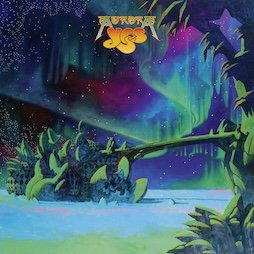
Yes Aurora
Yes – Aurora
Yes – Aurora
There’s two ways of looking at the new Yes album, Aurora. There’s the charitable way, and there’s the more critical way. Both ways are legitimate, and I’ll try to explain why. Let’s start with the charitable version: This is Yes’ 4th album with vocalist Jon Davison at the helm, and their second with this exact line-up. The major line-up change between 2014’s Heaven & Earth and today’s band is the rhythm section, since both Alan White and Chris Squire have sadly passed away. The line-up today is Jon Davison on vocals and various instruments, Steve Howe on a plethora of guitars, Geoff Downes on keyboards, Billy Sherwood on bass and some guitars, and Jay Schellen on drums.
On Aurora the band is occasionally augmented by the Czech National Symphony Orchestra. It’s impressive, and unexpected, that Yes is experiencing such a creative outburst at this very late stage in their career. Most bands of their vintage would be happy either retiring completely or relying on the nostalgia circuit to tour their greatest hits. Instead, Steve Howe & co. keep writing new music and releasing it. For that we should all be grateful.
The Jon Davison era got off to a rocky start, unfortunately. Heaven & Earth was, honestly, a terrible album, suffering from both low-energy performances and low-energy songwriting. It was an anaemic collection of new agey adult contemporary songs dressed in vaguely proggy garments, and suffering from Roy Thomas Baker’s (RIP) utterly phoned-in production job. Things got much better on 2021’s The Quest, which had some genuinely great songs (and some less stellar ones), and the even more proggy Mirror to the Sky (2023), which came with a 14-minute epic, no less.
Fast forward to today, and we have Aurora. Initial listens really surprised me. The band has challenged themselves with some tricky compositions and more adventurous playing than on any of the three previous albums. The first track, “Aurora”, was also the first single, and not a bad pick to represent the album. It’s a longish piece, at about seven and a half minute and opens with dramatic flourishes of piano and orchestra. It borders on schmaltzy, but the song improves once the intro is out of the way. Bouncy rhythms (including solid rhythm guitars from Davison) support a typically bright and serpentine Jon Davison melody. The thing that really drew me into this tune was the relatively bold use of key changes, which helps keep things interesting. It’s a Davison/Howe composition, and the two have obviously put care into the writing and arranging.
“Turnaround Situation” follows, a Davison tune with some very old-school Yes-ness in the rhythm guitars and rhythmic feel. The actual “turnaround situation” vocal hook grates a bit, but the rest of the song is actually quite good. As with some recent Yes, I’m getting slight Starcastle vibes, which is ironic, but also not the worst thing that could happen. We get a bit of acoustic noodling from Steve, and bubbly organ – not from Geoff but from Jon, it appears. Oddly enough, a lot of the keyboards on the album are handled by Jon and Steve. I guess Geoff is very busy with both the reformed Asia and with the excellent DBA. At least we do get more keys on this album, and some tasty lead work from Geoff as we’ll see. The outro of “Turnaround Situation” is too brief but excellent, with some Beach Boys-style harmonies.
“Love Lies Dreaming” comes next and is a personal favourite on Aurora. Lots of inimitable Howe-isms in the guitar department, both acoustic and electric. And here Jon’s melodies are excellent. He can sometimes trip himself up with too many detours and intricacies in his vocal lines, but here those intricacies are married to engaging and emotive melodies. There’s a section in the middle where Jon sings about forests and fields that is absolutely sublime. A highlight.
The grand epic, “Countermovement”, clocks in at close to 14 minutes, and is the first real disappointment on the album. Unlike the title track off the previous album, this is not a coherent piece at all, but odds and ends patched together in an unconvincing manner. And the individual parts aren’t in themselves engaging enough to make it worth the effort to grok the way they may be intended to fit together. There’s nothing downright bad here – no “Bumpy Ride”. But nothing spectacular either – and an epic needs spectacle. Many have made a point of not liking Steve’s lead vocal here. I don’t particularly mind it – his voice has actually gotten better with age. But the lyrics are pretty meh, and the melodies too. There’s an acoustic interlude here that is basically a retread of a certain Yes classic – you’ll know it when you hear it. You could hear that as a charming reminiscence or a pointless interjection – your choice. Geoff plays a bit of Mellotron, for what it’s worth. “Countermovement” picks up a bit at the 7-minute mark, where it basically becomes a new song, with a bit more gusto and better vocal sections, this time with Jon as lead vocalist. This second half reminds me of the better parts of the Keys to Ascension material. We get some nice lead synth from Geoff (I think it’s him, anyway), exchanging licks with Steve. This part is goodish, but like the entire song, it lacks fire. The song ends with a section where Steve pulls out his lap steel – clearly meant to be an epic ending, but it just sort of meanders. All in all, as epics go, underwhelming, and inferior to “Mirror to the Sky”.
Thankfully things improve vastly with “Ariadne”, my no. 1 pick of the litter. A stately, symphonic affair with Geoff Downes’ writing style all over it. Plucky strings from the orchestra, sweeping keyboards from Geoff, and a beautiful and vaguely Celtic verse melody from Jon carry this exploration of Greek myth. The arrangement is pretty much perfect, and the song rolls and waves pleasingly. A rockier mid-section has Billy doing some Squire-esque backing vocals – it all feels very properly Yes. Good job. This song would stand out even on a “classic” Yes album.
“All Hands on Deck” is a somewhat uncharacteristic rocker, with power chords and all. A hard rock shanty, perhaps. It shouldn’t really work, but it does. Billy’s bass is propulsive here, and I like the fact that Steve finally puts some hair on his guitar sound. There’s some cool fanfare-like synth from Geoff, and a pleasant acoustic outro from Steve. Not a substantial song, but a fun one.
“Outside the Box” is an “instrumental” of sorts. There’s lots of vocals, but they are wordless. This one almost gives off “Leaves of Grass” vibes, off Topographic. Some very tasty playing from all involved, especially Steve and Geoff, who again trade licks but this time with more panache. Odd, but cool tune.
The last proper track (not counting the bonus tracks) is Jon’s “Emotional Intelligence”. I have a hard time with this. There are some good parts – the verses are nice – but the chorus section, where he sings “emotional intelligence”, is oh so corny and schmaltzy that I can hardly bear it. File under “too twee”.
The bonus tracks are … well, exactly that. “Jambustin’” is skip-worthy in the extreme, whereas Billy’s acoustic ditty “Watching the River Flow” is quite nice – I’m getting Styx’ “Boat on the River” vibes. Nothing essential, though.
So that was my most charitable take on the album. Seen purely in the context of the Davison era, it’s quite a good album, and I especially appreciate that they are taking some chances and challenging themselves in the songwriting department. Apart from the lacklustre “epic” it’s a more complete album than any of the previous Davison albums.
Here comes the uncharitable part: For the sake of comparison, and in an effort to be fair so as not to compare Aurora to monolithic efforts like Close to the Edge, I put on 2011’s Fly From Here, the last full-length Yes album before Davison joined the band. I specifically put on the Return Trip version, where Trevor Horn had more freedom to fine-tune the sound and production. Keep in mind I only listened to the “Fly From Here” suite – God knows that album has some clunkers outside of the Trevor Horn/Geoff Downes material. But – what a difference a hyper-professional producer makes! This is my main gripe with all the Davison era records: Apart from Heaven & Earth, which sounds horrible, they are all competently produced and mixed. But merely competently. There is a sort of “meat and potatoes” feel to the production. Good enough, workmanlike, but nothing more. There’s no flair, and there’s one vital element that is missing.
You see, the true art of record producing is to convey emotion. From the performances to the recording to the mixing, the producer’s job is to ensure that the emotions of the songs are communicated strongly and clearly. And nowhere is that more important and apparent than in the vocals. The vocals need to hit the listener hard with the emotional content of the music. If not, all is lost. Listening to “Fly From Here”, with Trevor Horn’s vocals, is such a different experience from listening to Jon’s vocals on Aurora. Trevor’s voice is crystal clear, front and centre, confident and strong. There is no doubt about what he is communicating. And the production surrounding those vocals support the words and the emotions perfectly. Trevor Horn, as producer, helps the music tell the story it intends to tell. A tiny example – In “Sad Night at the Airfield”, Trevor sings about “that last intake of air”, and the music swells and “inhales” exactly on the word “air”. There are a million little production details like that in the “Fly From Here” suite, and it’s what makes it such a remarkable piece of music. And that’s the difference between that album and the Davison albums. The production is not narrative; it is merely presenting the music in a straightforward way. And Jon’s vocals never grab you and demand your attention. They are pleasant, but they are merely another sound in the arrangement. If you hear the title tracks of these two albums – Aurora and Fly From Here – back-to-back, you’ll hear the difference, and you’ll hear that Aurora’s production, and specifically its vocal production, is lacking.
A final critical note: The rhythm section on Aurora is oddly subdued. Jay Schellen’s drumming is supportive rather than propulsive, and Billy’s bass, though tasteful, could have been more prominent in the mix.
So there you have it. Two perspectives. You can choose which one you think is most valid. I think both have their merits. In the context of the Davison era, Aurora might be their best album yet. In the grander context of what Yes has achieved, it is a mere footnote, if a pleasant one.
Jacob Holm-Lupo
There’s two ways of looking at the new Yes album, Aurora. There’s the charitable way, and there’s the more critical way. Both ways are legitimate, and I’ll try to explain why. Let’s start with the charitable version: This is Yes’ 4th album with vocalist Jon Davison at the helm, and their second with this exact line-up. The major line-up change between 2014’s Heaven & Earth and today’s band is the rhythm section, since both Alan White and Chris Squire have sadly passed away. The line-up today is Jon Davison on vocals and various instruments, Steve Howe on a plethora of guitars, Geoff Downes on keyboards, Billy Sherwood on bass and some guitars, and Jay Schellen on drums.
On Aurora the band is occasionally augmented by the Czech National Symphony Orchestra. It’s impressive, and unexpected, that Yes is experiencing such a creative outburst at this very late stage in their career. Most bands of their vintage would be happy either retiring completely or relying on the nostalgia circuit to tour their greatest hits. Instead, Steve Howe & co. keep writing new music and releasing it. For that we should all be grateful.
The Jon Davison era got off to a rocky start, unfortunately. Heaven & Earth was, honestly, a terrible album, suffering from both low-energy performances and low-energy songwriting. It was an anaemic collection of new agey adult contemporary songs dressed in vaguely proggy garments, and suffering from Roy Thomas Baker’s (RIP) utterly phoned-in production job. Things got much better on 2021’s The Quest, which had some genuinely great songs (and some less stellar ones), and the even more proggy Mirror to the Sky (2023), which came with a 14-minute epic, no less.
Fast forward to today, and we have Aurora. Initial listens really surprised me. The band has challenged themselves with some tricky compositions and more adventurous playing than on any of the three previous albums. The first track, “Aurora”, was also the first single, and not a bad pick to represent the album. It’s a longish piece, at about seven and a half minute and opens with dramatic flourishes of piano and orchestra. It borders on schmaltzy, but the song improves once the intro is out of the way. Bouncy rhythms (including solid rhythm guitars from Davison) support a typically bright and serpentine Jon Davison melody. The thing that really drew me into this tune was the relatively bold use of key changes, which helps keep things interesting. It’s a Davison/Howe composition, and the two have obviously put care into the writing and arranging.
“Turnaround Situation” follows, a Davison tune with some very old-school Yes-ness in the rhythm guitars and rhythmic feel. The actual “turnaround situation” vocal hook grates a bit, but the rest of the song is actually quite good. As with some recent Yes, I’m getting slight Starcastle vibes, which is ironic, but also not the worst thing that could happen. We get a bit of acoustic noodling from Steve, and bubbly organ – not from Geoff but from Jon, it appears. Oddly enough, a lot of the keyboards on the album are handled by Jon and Steve. I guess Geoff is very busy with both the reformed Asia and with the excellent DBA. At least we do get more keys on this album, and some tasty lead work from Geoff as we’ll see. The outro of “Turnaround Situation” is too brief but excellent, with some Beach Boys-style harmonies.
“Love Lies Dreaming” comes next and is a personal favourite on Aurora. Lots of inimitable Howe-isms in the guitar department, both acoustic and electric. And here Jon’s melodies are excellent. He can sometimes trip himself up with too many detours and intricacies in his vocal lines, but here those intricacies are married to engaging and emotive melodies. There’s a section in the middle where Jon sings about forests and fields that is absolutely sublime. A highlight.
The grand epic, “Countermovement”, clocks in at close to 14 minutes, and is the first real disappointment on the album. Unlike the title track off the previous album, this is not a coherent piece at all, but odds and ends patched together in an unconvincing manner. And the individual parts aren’t in themselves engaging enough to make it worth the effort to grok the way they may be intended to fit together. There’s nothing downright bad here – no “Bumpy Ride”. But nothing spectacular either – and an epic needs spectacle. Many have made a point of not liking Steve’s lead vocal here. I don’t particularly mind it – his voice has actually gotten better with age. But the lyrics are pretty meh, and the melodies too. There’s an acoustic interlude here that is basically a retread of a certain Yes classic – you’ll know it when you hear it. You could hear that as a charming reminiscence or a pointless interjection – your choice. Geoff plays a bit of Mellotron, for what it’s worth. “Countermovement” picks up a bit at the 7-minute mark, where it basically becomes a new song, with a bit more gusto and better vocal sections, this time with Jon as lead vocalist. This second half reminds me of the better parts of the Keys to Ascension material. We get some nice lead synth from Geoff (I think it’s him, anyway), exchanging licks with Steve. This part is goodish, but like the entire song, it lacks fire. The song ends with a section where Steve pulls out his lap steel – clearly meant to be an epic ending, but it just sort of meanders. All in all, as epics go, underwhelming, and inferior to “Mirror to the Sky”.
Thankfully things improve vastly with “Ariadne”, my no. 1 pick of the litter. A stately, symphonic affair with Geoff Downes’ writing style all over it. Plucky strings from the orchestra, sweeping keyboards from Geoff, and a beautiful and vaguely Celtic verse melody from Jon carry this exploration of Greek myth. The arrangement is pretty much perfect, and the song rolls and waves pleasingly. A rockier mid-section has Billy doing some Squire-esque backing vocals – it all feels very properly Yes. Good job. This song would stand out even on a “classic” Yes album.
“All Hands on Deck” is a somewhat uncharacteristic rocker, with power chords and all. A hard rock shanty, perhaps. It shouldn’t really work, but it does. Billy’s bass is propulsive here, and I like the fact that Steve finally puts some hair on his guitar sound. There’s some cool fanfare-like synth from Geoff, and a pleasant acoustic outro from Steve. Not a substantial song, but a fun one.
“Outside the Box” is an “instrumental” of sorts. There’s lots of vocals, but they are wordless. This one almost gives off “Leaves of Grass” vibes, off Topographic. Some very tasty playing from all involved, especially Steve and Geoff, who again trade licks but this time with more panache. Odd, but cool tune.
The last proper track (not counting the bonus tracks) is Jon’s “Emotional Intelligence”. I have a hard time with this. There are some good parts – the verses are nice – but the chorus section, where he sings “emotional intelligence”, is oh so corny and schmaltzy that I can hardly bear it. File under “too twee”.
The bonus tracks are … well, exactly that. “Jambustin’” is skip-worthy in the extreme, whereas Billy’s acoustic ditty “Watching the River Flow” is quite nice – I’m getting Styx’ “Boat on the River” vibes. Nothing essential, though.
So that was my most charitable take on the album. Seen purely in the context of the Davison era, it’s quite a good album, and I especially appreciate that they are taking some chances and challenging themselves in the songwriting department. Apart from the lacklustre “epic” it’s a more complete album than any of the previous Davison albums.
Here comes the uncharitable part: For the sake of comparison, and in an effort to be fair so as not to compare Aurora to monolithic efforts like Close to the Edge, I put on 2011’s Fly From Here, the last full-length Yes album before Davison joined the band. I specifically put on the Return Trip version, where Trevor Horn had more freedom to fine-tune the sound and production. Keep in mind I only listened to the “Fly From Here” suite – God knows that album has some clunkers outside of the Trevor Horn/Geoff Downes material. But – what a difference a hyper-professional producer makes! This is my main gripe with all the Davison era records: Apart from Heaven & Earth, which sounds horrible, they are all competently produced and mixed. But merely competently. There is a sort of “meat and potatoes” feel to the production. Good enough, workmanlike, but nothing more. There’s no flair, and there’s one vital element that is missing.
You see, the true art of record producing is to convey emotion. From the performances to the recording to the mixing, the producer’s job is to ensure that the emotions of the songs are communicated strongly and clearly. And nowhere is that more important and apparent than in the vocals. The vocals need to hit the listener hard with the emotional content of the music. If not, all is lost. Listening to “Fly From Here”, with Trevor Horn’s vocals, is such a different experience from listening to Jon’s vocals on Aurora. Trevor’s voice is crystal clear, front and centre, confident and strong. There is no doubt about what he is communicating. And the production surrounding those vocals support the words and the emotions perfectly. Trevor Horn, as producer, helps the music tell the story it intends to tell. A tiny example – In “Sad Night at the Airfield”, Trevor sings about “that last intake of air”, and the music swells and “inhales” exactly on the word “air”. There are a million little production details like that in the “Fly From Here” suite, and it’s what makes it such a remarkable piece of music. And that’s the difference between that album and the Davison albums. The production is not narrative; it is merely presenting the music in a straightforward way. And Jon’s vocals never grab you and demand your attention. They are pleasant, but they are merely another sound in the arrangement. If you hear the title tracks of these two albums – Aurora and Fly From Here – back-to-back, you’ll hear the difference, and you’ll hear that Aurora’s production, and specifically its vocal production, is lacking.
A final critical note: The rhythm section on Aurora is oddly subdued. Jay Schellen’s drumming is supportive rather than propulsive, and Billy’s bass, though tasteful, could have been more prominent in the mix.
So there you have it. Two perspectives. You can choose which one you think is most valid. I think both have their merits. In the context of the Davison era, Aurora might be their best album yet. In the grander context of what Yes has achieved, it is a mere footnote, if a pleasant one.
This review came from Guest ReviewerJacob Holm-Lupo.
Date Monday 15th June 2026